Category Archives: Uncategorized

Exciting News About My Barbara La Marr Biography!

On the anniversary of Barbara’s birthday, July 28, 1896, I am very happy to report that after submitting the completed manuscript of my Barbara La Marr biography to an esteemed publisher several months back, the publisher distributed it to an anonymous panel of expert readers (authors, film historians, etc.) and it has received wonderful feedback thus far.

Here’s what a couple of non-anonymous readers have to say:

“Sherri Snyder digs deep into the life of Barbara La Marr, giving an in-depth look at the intelligence and talents of the “Girl Who Was Too Beautiful.”  We see the real three-dimensional La Marr for the very first time, a thoughtful, generous, and creative woman who died much too young.” —-Mary Mallory, film historian and author (Hollywood Celebrates the Holidays: 1920-1970, Hollywoodland: Tales Lost and Found, and Hollywood at Play: The Lives of the Stars Between Takes)

“Snyder’s completed manuscript is impressive in both its scope and detail…a fluid and captivating narrative.” —Christina Rice, author (Ann Dvorak: Hollywood’s Forgotten Rebel)

Meticulously compiled from myriad sources—including never-before-released information from Donald Gallery (Barbara’s son) and descendants of people close to Barbara, Barbara’s private diary, memoirs of those who knew and romanced her, and an extensive collection of Barbara’s poetry—the book, tentatively titled Barbara La Marr: The Girl Who Was Too Beautiful, presents an intimate look at Barbara’s life story, told in its entirety for the first time.  I thank everyone from around the globe who has expressed avid interest in the book and offered kind encouragement throughout the years!  It was Donald Gallery’s lifelong dream that his mother’s complete, long overdue biography be written;  I sincerely thank him for entrusting me with that dream.  I am honored and excited to present this book to the world and will post publication details as soon as I have them.  Meanwhile, I offer an overview of the book below.

*  *  *

In 1914 at age seventeen, strong-willed, already infamous Reatha Watson was declared by juvenile authorities to be “too beautiful for the city” and banished from Los Angeles.  She soon returned, only to become further mired in scandal and subsequently barred by the film studios from working as an actress.

Unwilling to stifle her burning ambition and manifold talents, she pressed forward, reborn as Barbara La Marr.  An innately gifted dancer, she achieved renown in the foremost cabarets throughout the country and on Broadway at the height of the pre-WWI dance craze.  Then she toured the vaudeville circuits, acting in headlining comedy skits to general acclaim.  Still under the guise of her assumed name, she next became a storywriter for the Fox Film Corporation in the same town that cast her out, earning the modern equivalent of a six-figure salary.  Her exotic beauty, curvaceous form, and potent presence, epitomizing an ascending breed of 1920s screen idol—a shameless, volatile woman who ensnared men with her femininity—enticed film producers.  She temporarily averted association with her increasingly turbulent past long enough to reign as a preeminent sex goddess of the silent screen.

Through it all, her tumultuous private life striped the pages of newspapers and film magazines.  After her death at age twenty-nine caused a furor in downtown Los Angeles in 1926, her publicist confessed, “There was no reason to lie about Barbara La Marr…Everything she said, everything she did was colored with news-value.  A personality dangerous, vivid, attractive; a desire to live life at its maddest and fullest; a mixture of sentiment and hardness, a creature of weakness and strength—that was Barbara La Marr.”

Her extraordinary life story is one of tempestuous passions and unbending perseverance in the face of inconceivable odds.  It is of a woman’s fierce determination to forge her own destiny amid the constant threat of losing it all to scandal and, ultimately, death.

B19

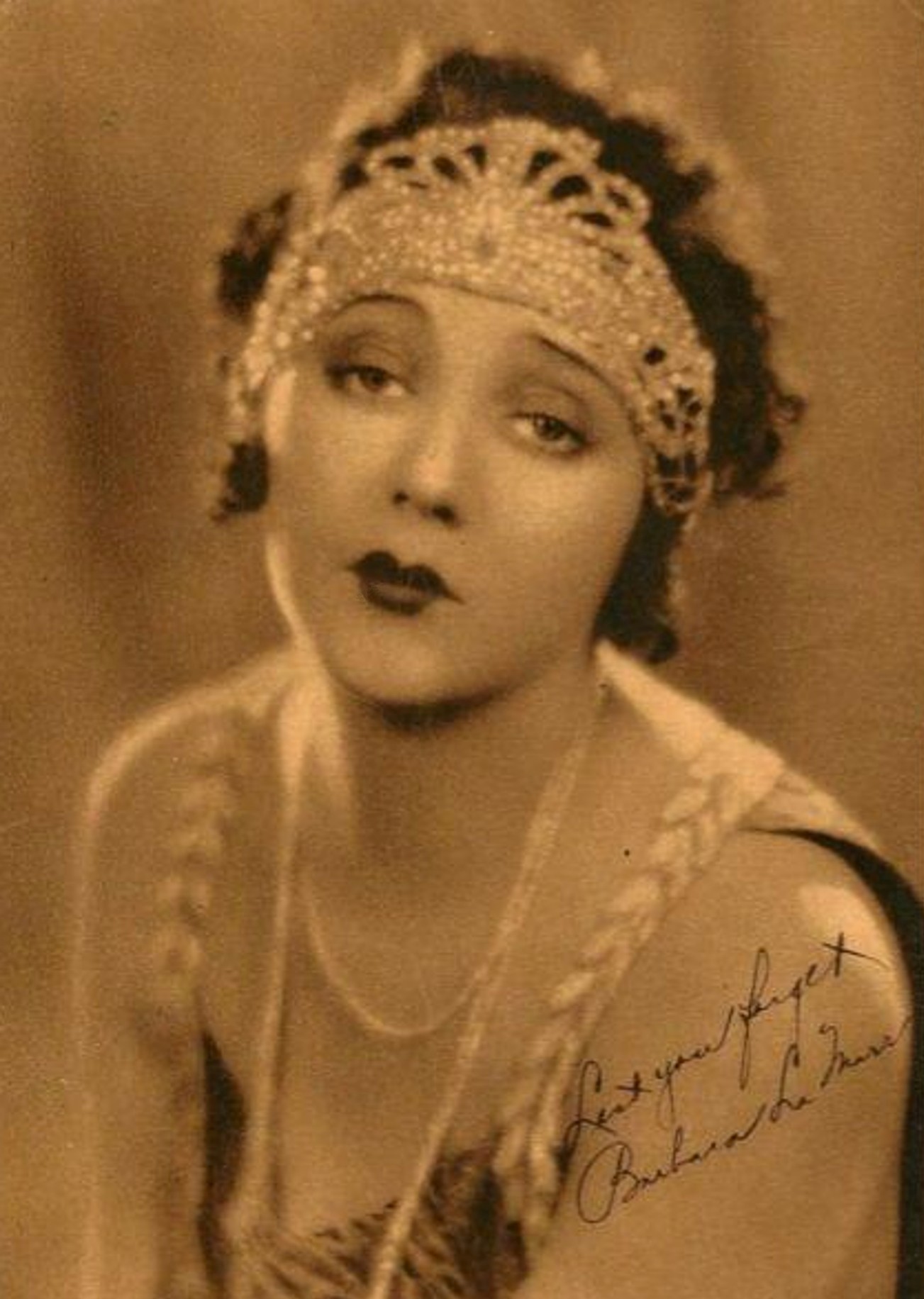
“Lest you forget—Barbara La Marr”

Blog Entries Will Return…

As I complete my Barbara La Marr biography (refer to the Book Updates section for more information), blog entries are temporarily on hold.  Rest assured, however, they will be back!  Many exciting things are happening behind the scenes and there is much I am looking forward to sharing (including many more images of the lovely and talented Miss La Marr).

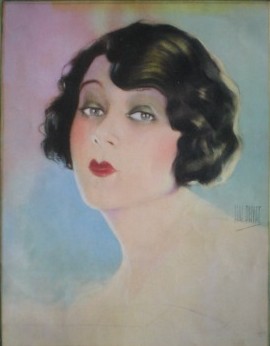
For now, I leave you with the striking imagery of illustrator and photographer Herold Rodney Eaton Phyfe (better known as Hal Phyfe).  Phyfe utilized his background in sculpting and painting to produce illustrated portraits for film studios and magazines throughout the 1920s.  His renderings, often done in pastels, melded his dramatic flair with his ability to capture the subtle intricacies of his subjects’ personas.  “If the eyes have ‘it’,” he believed, “everything else will be forgotten in their vivid, compelling attraction.  Eyes create individuality, they are the spokesman for the soul, the character, the mind.”

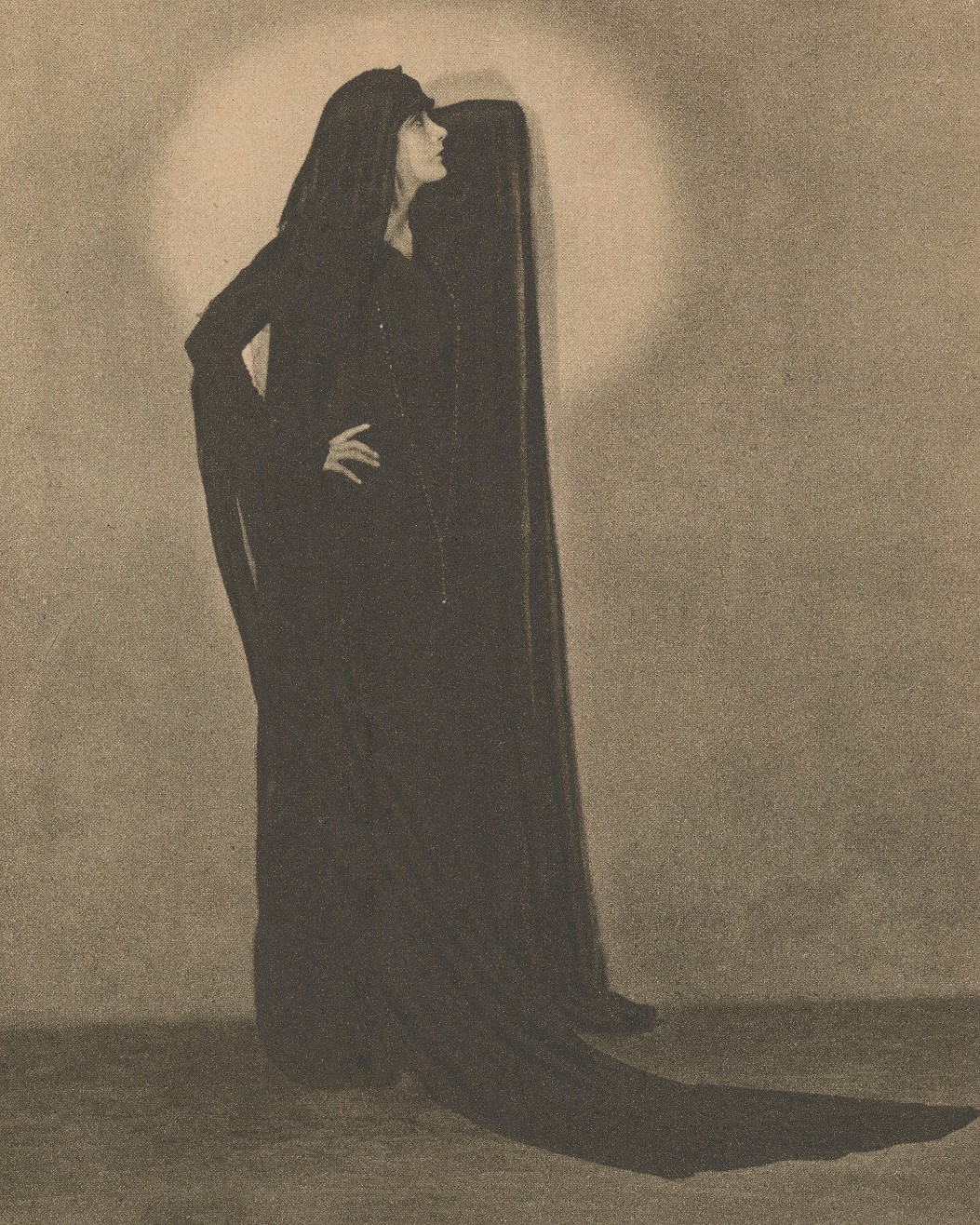
An image of Barbara from a promotional brochure for her 1924 film Sandra.

An image of Barbara from a promotional brochure for her 1924 film Sandra.

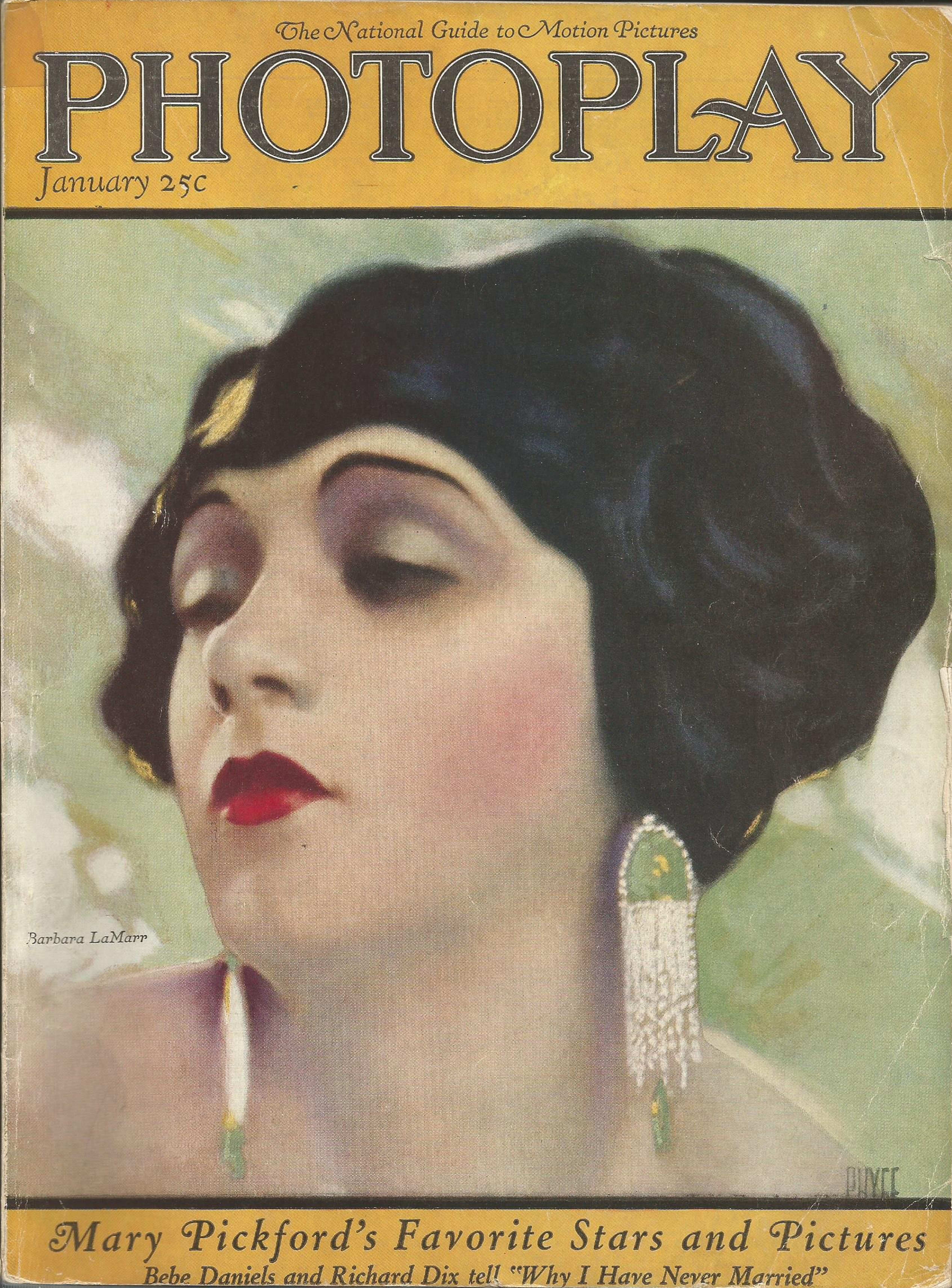
Photoplay cover featuring Barbara, January 1924.

Notes:

“If the eyes have ‘it’,”: Shields, David S., “Hal Phyfe,” https://www.broadway.cas.sc.edu/content/hal-phyfe.

A Vamp There Was

Vamp

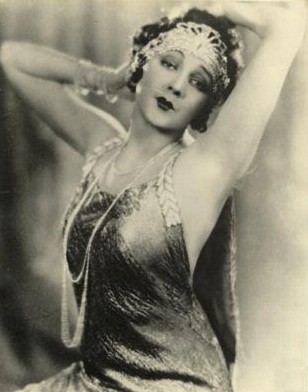
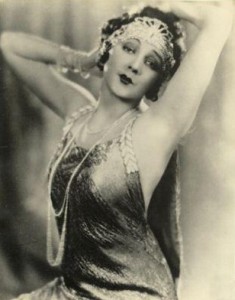
Barbara, photographed by Hoover Art Studios, during her ascension to worldwide fame.

The vamp first emerged on the screen in 1915.  She came in the form of Theda Bara in A Fool There Was, a film inspired by Rudyard Kipling’s poem, “The Vampire.”  She was a shocking figure: a woman who deliberately uses her femininity to ensnare men.  To some, she was a titillating deviation, the antithesis of the standard saccharine heroine.  To others, she was cause for alarm, an additional threat to society’s diminishing Victorian morals.  To film producers, she was gold, the precursor to a new breed of screen goddess.

In 1922, Barbara La Marr secured her launch to superstardom when she played a vamp in Rex Ingram’s Trifling Women.  Her portrayal of a cruel sorceress who plays men like pawns solidified her image as one of the silent screen’s leading temptresses.  At first, Barbara welcomed the opportunity to play vamps.  “I’m not silly enough to pretend I’m an ingénue,” she conceded. “It isn’t my line—on or off the screen.  I don’t want to be an ingénue.  I just want to be a woman.”

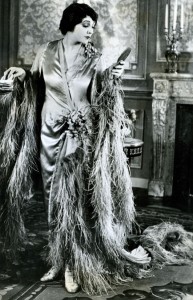
Barbara could indeed vamp with the best of them.  Director Fred Niblo once marveled that even a bad dressmaker couldn’t make her look virtuous.  Barbara likewise quipped that a true vamp was not dependent upon her bee-stung lips or the clinging gowns, trailing hemlines, and jeweled headpieces in which she was typically costumed.  “It’s the look in the eye that does it,” she insisted.  Yet Barbara’s style of vamping went beyond the popular conception of the vamp as a dimensionless caricature.  An actress of true substance, she alternately infused her roles with sprightly comedic touches and, more often, gripping, heartfelt emotion.  She, like the women she portrayed, was enshrouded in an aura of mystery.  “She is made for lurking tragedy,” writer Willis Goldbeck mused in the November 1922 issue of Motion Picture Magazine, “…one feels the beat of ravens’ wings about her…her radiance is that of moonlight in the heavy shadows of the night…Calypso she is, burning with the flame of subtle ecstasy.”

Even so, reporters and magazine columnists, upon meeting Barbara in the flesh, were pleasantly startled.  They were hard-pressed to find the slightest trace of the wicked ladies she enacted in films.  Adela Rogers St. Johns recalled how Barbara’s genuine charm and captivating wit disarmed even the most hardened newspapermen.  When one interviewer pressed Barbara to reveal something unusual about herself, she offered to stand on her head.  Los Angeles Times reporter William Foster Elliot, struck by her sincerity and directness, commented, “She is remarkably straightforward and man to man in her attitude,” and “…really human despite the exotic bunk.”

Barbara eventually tired of playing wayward women and shunned vamp roles altogether.  She yearned to play the more sympathetic roles she had proven herself capable of in such films as Louis B. Mayer’s production, Thy Name Is Woman (1924).  By 1925, public tastes were similarly shifting and fun-loving flappers began eclipsing vamps as the newest idols of the silver sheet.  Barbara, inextricably linked to her naughty onscreen image and declared washed-up in the trade magazines, fought for one final chance.

With her health failing and less than a year to live, she was given that chance.  She was determined to see it through…

©2013 Sherri Snyder
Richelieu Pearls 1924

Promotional image for Sandra (1924)

Heart of a Siren 1925

Film still from The Heart of a Siren (1925)


Notes:

“I’m not silly enough”: La Marr, Barbara, “Why I Adopted a Baby,” Photoplay, May 1923, pg. 31.

“It’s the look in the eye”: Drummond, Joan, “Beautiful Barbara,” Pictures and the Picturegoer, April 1924, pg. 44.

“She is remarkably straightforward”: Elliot, Foster William , “Not Like the Fan Stories,” Los Angeles Times, September 17, 1922.